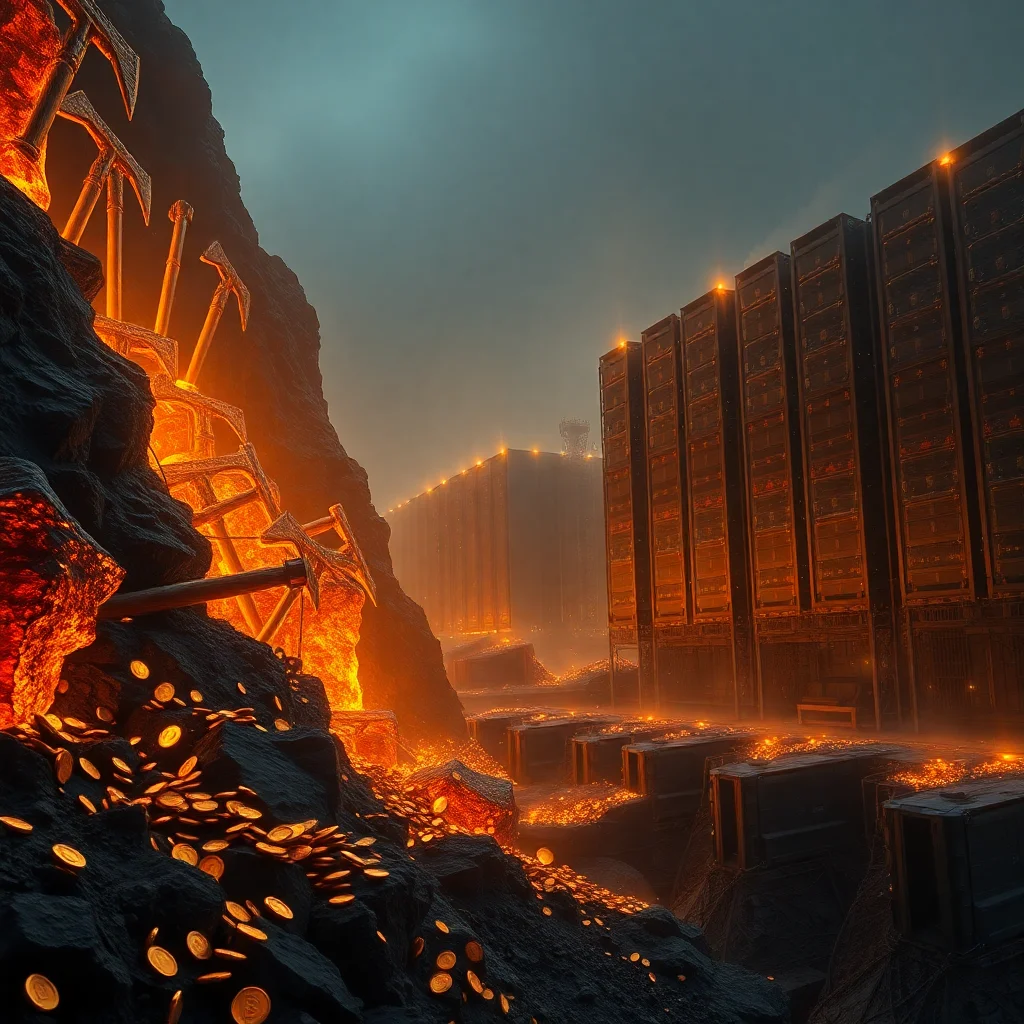
The bitcoin mining industry is undergoing a dramatic transformation. What was once a straightforward business—deploy hardware, secure the network, collect block rewards—is rapidly evolving into something far more complex. With production costs for bitcoin reaching $79,995 per coin in the last quarter while bitcoin trades around $70,000, the fundamental economics no longer support traditional mining operations. This structural squeeze is forcing major publicly-traded miners to make an unprecedented strategic pivot: becoming AI infrastructure companies while liquidating their bitcoin treasuries to fund the transition.
The Profitability Crisis: When Costs Exceed Value
The statistics tell a stark story. According to recent data, the average public bitcoin miner spent $79,995 to produce a single bitcoin in the third quarter—a figure that leaves virtually no margin for profit when bitcoin hovers around $70,000. This represents a fundamental disconnect in the mining economics that powered the industry for over a decade. For context, when bitcoin was trading above $60,000 in early 2021, miners could operate profitably even with rising electricity costs. Today's environment is fundamentally different.
This crisis didn't emerge overnight. The combination of several factors created this perfect storm: increased network difficulty, rising electricity costs in certain jurisdictions, upgraded competition deploying newer ASIC hardware, and the simple reality that the bitcoin block reward halving in April 2024 reduced miner revenues by 50%. Meanwhile, the amount of capital invested in mining infrastructure continued to grow, spreading available rewards across more competitors.
Large-cap miners like Marathon Digital, Riot Platforms, and others that once proudly displayed multi-thousand bitcoin treasuries now face pressure from shareholders questioning why they're holding an asset that costs more to produce than it's worth. The mathematics are inexorable: negative unit economics demand action.
The AI Infrastructure Pivot: From Hash Power to Computing Power
Instead of exiting the industry entirely, forward-thinking miners recognized an opportunity in their existing competitive advantages. Bitcoin mining operations require substantial electrical infrastructure, real estate with reliable power supply, sophisticated cooling systems, and expertise in managing large-scale computational operations. These same attributes are precisely what companies building artificial intelligence infrastructure need.
Major miners have begun securing massive contracts to provide GPU computing capacity for AI model training and inference. The market for this infrastructure is exploding as companies like OpenAI, Anthropic, Meta, and countless others race to develop advanced language models and other AI systems. Estimates suggest the mining industry has secured approximately $70 billion in AI infrastructure contracts—a remarkable pivot that demonstrates the sector's adaptability.
This transition isn't merely theoretical. Several publicly-traded miners have announced significant partnerships and infrastructure buildouts specifically designed for AI workloads. The appeal is clear: AI infrastructure generates more consistent revenue per unit of power consumed than bitcoin mining, especially given current mining economics. A single kilowatt of electricity powering an AI GPU can generate substantially more revenue than that same kilowatt directed toward bitcoin ASICs when bitcoin production costs exceed market price.
Strategic Bitcoin Liquidations and Treasury Management
To fund this massive infrastructure transition, miners have begun liquidating bitcoin holdings that were once considered sacred assets. For years, major miners accumulated bitcoin as a core strategy—holding block rewards and maximizing treasury size was seen as a path to long-term value creation. This narrative has shifted dramatically.
The liquidation pattern tells an important story about market dynamics:
- Funding the Transition: Selling bitcoin provides immediate capital for GPU procurement, facility upgrades, and power infrastructure improvements without requiring dilutive equity raises
- Market Timing Considerations: Miners are liquidating at various price points, suggesting they don't view current prices as representing exceptional value given production costs
- Signaling Effect: Large-scale treasury liquidations by major miners can influence market sentiment, though the actual volumes remain relatively modest compared to total market capitalization
- Balance Sheet Optimization: Converting an illiquid asset (held bitcoin) into productive infrastructure improves operational metrics and cash flow visibility
This represents a philosophical shift in miner strategy. Rather than viewing bitcoin holdings as a store of value that will appreciate dramatically, miners increasingly view bitcoin as a byproduct of their mining operations—a commodity to be monetized and reinvested into more profitable infrastructure ventures.
Broader Implications for Bitcoin and Mining
The structural shift in mining strategy carries significant implications. On one hand, it represents pragmatic adaptation to changed market conditions. Miners are capital-constrained businesses that must generate returns; pivoting to higher-margin infrastructure businesses is rational behavior. On the other hand, the strategic shift raises questions about miner dedication to bitcoin's security and long-term vision.
Historically, major miners served as long-term holders and stakeholders in bitcoin's success. When miners view bitcoin primarily as a commodity to be liquidated for capital reinvestment, it potentially changes the incentive structure that has powered network security for fifteen years. This doesn't mean the network is at risk—proof-of-work security remains robust—but it signals that the industry's relationship with bitcoin is evolving.
The move also highlights that bitcoin mining has matured from a frontier industry into something more like traditional infrastructure—where players must diversify revenue streams and optimize capital allocation like any other business. The days of single-purpose mining companies dedicated entirely to bitcoin production may be ending.
What Comes Next for the Industry
The trajectory seems clear: bitcoin mining companies will increasingly function as diversified infrastructure operators. The relative contribution of bitcoin mining revenue to overall business performance will likely decrease as AI infrastructure becomes central to operations. This transition will take years to fully mature, but the direction is set.
Investors, network participants, and observers should monitor how this evolution affects bitcoin's security, decentralization, and long-term viability. A mining industry that's partially focused on alternate revenue streams will behave differently than one entirely dependent on block rewards. Whether this represents evolution or dilution remains an open question, but one thing is certain: the bitcoin mining industry of 2025 will look radically different from the one that existed just two years ago.
This article was last reviewed and updated in May 2026.